
How to Fuel Your First 50K: The Ultramarathon Nutrition Plan That Starts With Your Watch Data
Your marathon fueling plan won't work for a 50K. Here's how to build an ultra nutrition strategy using your wearable data.
In Summary
- Marathon fueling advice breaks down after 26.2 miles — ultras need a different framework.
- Your 50K nutrition plan should combine gels, real food, and liquid calories across 4–7 hours.
- Train your gut to handle 60–80g of carbs per hour before race day, not on it.
- Your watch data already holds the inputs for a personalised ultra fueling plan.
You finished your first marathon. Maybe your second or third. And at some point the thought landed: what if I went further?
A 50K — 31.07 miles — is the most popular entry point into ultramarathons. It's long enough to feel genuinely different from a marathon, but short enough that your existing fitness can carry you there with the right build-up.
The running part? You can train for that. The fueling part is where most first-time ultra runners get into trouble.
Marathon nutrition advice dominates the internet, and for good reason — there are roughly ten times as many marathon finishers as ultra finishers each year. But when you try to stretch a marathon fueling plan across 4 to 7 hours of running, the wheels come off. The physiology is different, the logistics are different, and the gut demands are different.
Here's how to build a 50K nutrition plan that actually works — starting with the data your watch is already collecting.
Why marathon fueling breaks at 50K
A marathon fueling plan typically covers 2.5 to 5 hours of effort. You start with full glycogen stores, take gels every 30 to 45 minutes, drink at aid stations, and aim for 60 to 90 grams of carbohydrate per hour.
That framework isn't wrong. But a 50K adds 1 to 3 extra hours of running, and that changes three things fundamentally.
Your glycogen debt compounds. By the time you pass 26.2 miles, your glycogen stores are largely depleted regardless of how well you've fueled. You're now running almost entirely on exogenous carbohydrate and fat oxidation. The margin for fueling mistakes shrinks to zero.
Your gut slows down. After 3 to 4 hours of running, blood flow to the gut decreases as your body prioritises working muscles. Absorption rates drop. A gel that sat fine at hour 2 can cause nausea at hour 5. This is why real food and liquid calories become essential — they're easier to absorb when your GI system is under stress.
Conditions change over the distance. A 50K that starts at 7am might finish in midday heat. Your sweat rate at mile 5 will be different from your sweat rate at mile 28. A static hydration plan built for one set of conditions doesn't hold across that range.
The three-fuel framework for your first 50K
Marathoners can usually get away with a single fuel source — gels plus water. Ultra runners need a broader toolkit. Think of your race nutrition as three fuel channels that you'll blend across the day.
Channel 1: Fast carbs (gels, chews, drink mix)
These are your primary energy source for the first 20 miles and remain part of the plan throughout. They digest quickly and deliver glucose and fructose to working muscles within 15 to 20 minutes.
For a 50K, aim for 60 to 80 grams of carbohydrate per hour. Start fueling at 20 to 25 minutes into the race — earlier than you might for a marathon — because you need to protect glycogen stores for a longer effort.
Use a glucose-fructose combination (often called dual-transport carbs) to maximise absorption. Your gut can absorb roughly 60g of glucose per hour through one intestinal pathway, plus an additional 30g of fructose through a separate pathway. Most modern gels and drink mixes are already formulated this way.
Channel 2: Real food (bars, bananas, potatoes, sandwiches)
This is the big shift from marathon fueling. After 3 hours of gels, your body often starts rejecting sweet, concentrated carbohydrate. Flavour fatigue is real, and so is the GI distress that comes from hours of concentrated sugar.
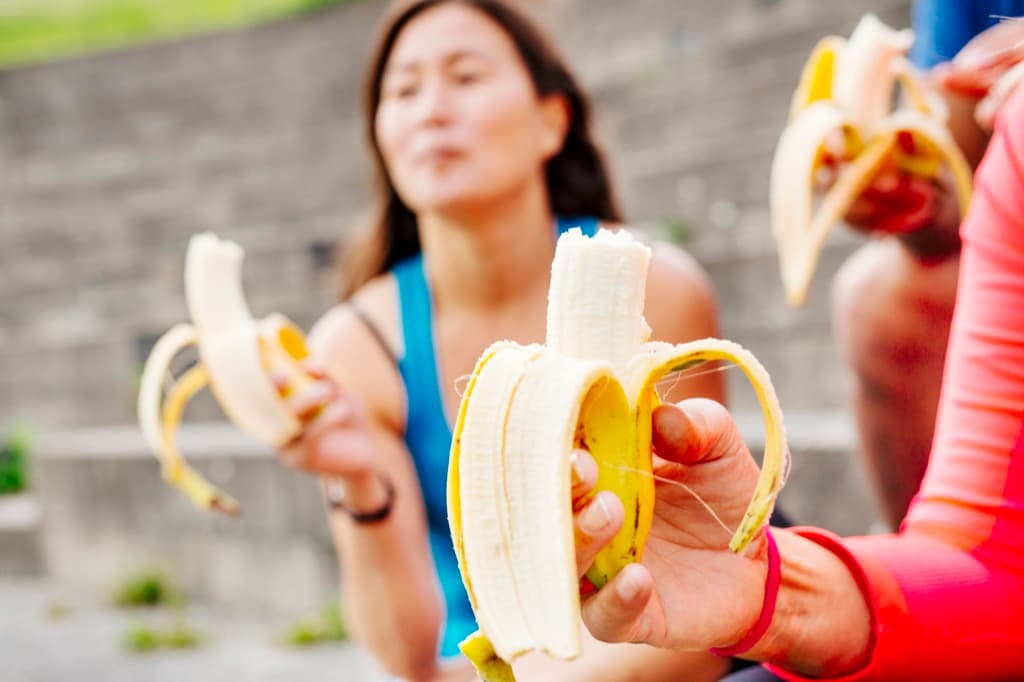
Real food provides variety, palatability, and slower-release energy that complements your fast carbs. The classic ultra foods — boiled potatoes with salt, PB&J squares, banana pieces, rice balls — exist for a reason: they sit well in a stressed gut.
Start introducing real food bites from hour 3 onwards, or earlier if you know gels don't agree with you. Alternate between sweet and savoury to manage palate fatigue.
Channel 3: Liquid calories (sports drink, broth, cola)
Liquid calories serve double duty — they deliver carbohydrate while contributing to your fluid intake. In the later stages of a 50K, when chewing feels like effort and your stomach is touchy, a cup of cola or warm broth at an aid station can be the most effective fueling move.
If you're using a sports drink in your bottles or hydration vest, count those carbs toward your hourly target. A typical 500ml serving of sports drink contains 30 to 40g of carbohydrate.
How your watch data shapes the plan
Here's where most 50K nutrition advice falls short: it gives you generic ranges. "Drink 500 to 800ml per hour." "Eat 200 to 300 calories per hour." Those ranges are so wide they're nearly useless.
Your watch narrows them.
Sweat rate
If you've done long runs with a Garmin or Apple Watch, you have the raw data to estimate your sweat rate. Weigh yourself before and after a long run (without drinking during the run), and the weight difference in grams is roughly your fluid loss. Divide by the run duration in hours and you have your hourly sweat rate.
Most runners lose 500 to 1500ml per hour depending on body size, fitness, and heat. Your number tells you how much fluid to target — not a generic range.
The important insight for a 50K: your sweat rate will be higher in the later miles if conditions warm up. Plan for the worst hour, not the average.
Heart rate and training load
Your average heart rate during long runs tells you how hard your body is working, which directly correlates with how much carbohydrate you're burning per hour. A higher heart rate means a higher proportion of energy comes from carbs rather than fat, which means you need to replace more.
If your heart rate creeps above zone 3 consistently during long runs, you're burning through glycogen faster than someone running in zone 2. Your fueling plan needs to account for this.
Heart rate drift
Heart rate drift — when your heart rate rises over a long run even though your pace stays the same — is one of the most underused signals from your watch. It's a strong indicator of dehydration and cardiovascular strain.
If your long runs show significant heart rate drift after 90 minutes, you're likely under-hydrating. This is critical information for a 50K where you'll be running for 4 to 7 hours.
Building your personalised 50K plan
Here's a practical framework you can build from your training data.
Step 1: Calculate your carb target
For a 50K, target 60 to 80g of carbohydrate per hour. If you finish in 5 hours, that's 300 to 400g total. Map out how you'll get there:
- Gels: 25g each (typical) — you might use 6 to 8 across the race
- Sports drink: 30 to 40g per 500ml
- Real food: a banana is ~25g, a PB&J quarter is ~20g
- Cola or broth at aid stations: 10 to 15g per cup
Step 2: Calculate your fluid target
Use your sweat rate data from training. If you lose 900ml per hour in warm conditions, aim to replace 70 to 80% of that — roughly 630 to 720ml per hour. You don't need to replace 100% of sweat losses during the race; trying to do so increases the risk of GI distress and hyponatremia.
Step 3: Map your fueling to the course
Study the aid station locations. Know what each station offers. Decide in advance which stations you'll use for gels, which for real food, and which for just fluids.
For a 50K with aid stations every 5 miles, you might fuel at every station but with different items: gel at mile 5, sports drink at mile 10, banana and water at mile 15, gel at mile 20, broth and cola at mile 25, and so on.
Step 4: Test it in training
You have 3 to 4 long runs left before your race (if you're reading this 6 to 8 weeks out). Each one is a fueling dress rehearsal.
- Long run 1: Test your gel brand and timing at your target carb rate (60g/hour minimum).
- Long run 2: Introduce real food alongside gels after 2 hours. Note what sits well.
- Long run 3: Simulate race conditions as closely as possible. Carry everything you'll carry on race day. Practise eating on the move.
- Long run 4 (final long before taper): Full dress rehearsal. Run your complete fueling plan for at least 3 hours.
If something causes GI distress in training, it will cause GI distress on race day. Change it now.
The mistakes that catch first-time ultra runners
Starting too conservatively. Marathon instincts tell you to be cautious with fueling in the early miles. In a 50K, this creates a calorie deficit that compounds into a bonk at mile 25. Start fueling at 20 minutes and stay consistent.
Ignoring sodium. A 50K in warm conditions can mean 4 to 7 hours of sodium loss through sweat. Gels and sports drinks contain some sodium, but heavy sweaters may need supplemental salt capsules or electrolyte tabs. Your watch data can help estimate losses — if your heart rate drift is significant and you're drinking enough fluid, sodium depletion is a likely culprit.
Not practising aid station logistics. Knowing what to eat is half the equation. Knowing how to eat it while moving — opening wrappers with sweaty hands, eating while breathing hard, drinking without choking — is the other half. Practise in training.
Using only sweet fuel. By hour 4, the thought of another sweet gel can trigger genuine nausea. Plan for savoury options. Boiled potatoes dipped in salt, pretzels, and broth are ultra staples for a reason.
From data to plan
Your Garmin or Apple Watch captures the raw inputs — sweat rate proxies, heart rate trends, training load, calorie burn estimates. But translating those numbers into a specific fueling plan for a 50K still requires manual calculation that most athletes skip.
Sweatr does this automatically. It pulls your wearable data, factors in the race distance and your finishing time estimate, and builds a personalised carb-and-fluid plan mapped to your effort. For a 50K, where the margin for fueling error is thinner than a marathon, having a plan built from your actual data — not a generic range from a blog post — is the difference between crossing the finish line strong and walking the last 5 miles wondering what went wrong.
Your watch has the data. Your legs have the training. Now your fueling plan needs to match both.