
5 Watch Metrics That Should Shape Your Race-Day Fueling Plan
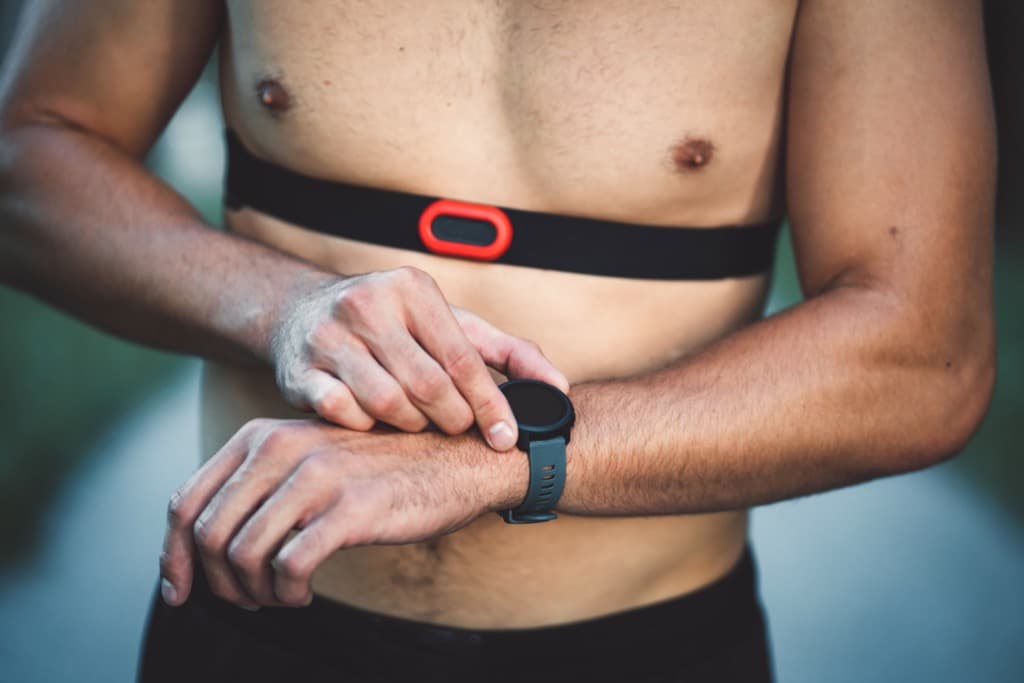
Your Garmin or Apple Watch already tracks the data you need to build a smarter fueling plan. Here's how to use it.
In Summary
- Your watch tracks the five inputs that determine how much you should eat and drink on race day.
- Heart rate, duration, temperature, pace, and training load all change your fueling needs — most plans ignore them.
- A long run in 30°C heat at 150 bpm burns through glycogen and fluid far faster than the same distance in cool weather.
- Sweatr pulls these metrics from your Garmin, Apple Watch, and Strava to build a plan that fits your body.
Your watch is recording everything you need to build a better fueling plan. Heart rate, pace, workout duration, ambient temperature, training load — it is all sitting in Garmin Connect or Apple Health right now. The problem is that nobody is connecting those numbers to what you eat and drink on race day.
Most fueling guides hand you a generic formula. Take a gel every 45 minutes. Drink 500 ml per hour. Aim for 60 grams of carbs. That advice is not wrong, exactly — it is just incomplete. It treats every runner, every race, and every condition as identical. Your watch knows they are not.
Here are the five metrics your watch already tracks that should directly shape your fueling plan — and how to actually use them.
1. Heart Rate During Effort
Heart rate is the single best proxy for how hard your body is working, and working harder means burning through glycogen faster. A runner holding 145 bpm for three hours has fundamentally different fueling needs from someone averaging 165 bpm over the same distance.
Higher heart rates also affect your gut. When your heart rate climbs above roughly 80 percent of your max, blood gets redirected away from your digestive system and toward your working muscles. That is why a gel that goes down fine on an easy long run can make you nauseous during a tempo effort or on race day when adrenaline pushes your heart rate higher than training.
What to do with this: Look at your average heart rate across your last four long runs. If your race-day heart rate will be significantly higher — and it almost always is — you need to start fueling earlier and in smaller doses. A higher heart rate means faster glycogen depletion and less gut tolerance. Both push you toward more frequent, smaller feeds rather than fewer large ones.
2. Workout Duration (Not Distance)
A 20-mile training run and a marathon are the same distance but potentially very different durations. A 3:15 marathoner and a 4:45 marathoner both cover 26.2 miles. The slower runner is on their feet 90 minutes longer, burns through more total energy, and needs substantially more fuel — not less.
This is one of the most common mistakes in race nutrition. Generic plans are often built for sub-4:00 marathoners. If your marathon takes five hours, you need more gels, more fluid, and a different pacing strategy for your nutrition than the plan in your running magazine assumes.
Your watch knows your pace. More importantly, it knows your predicted finish time based on your training data. That predicted duration is the number your fueling plan should be built on.
What to do with this: Estimate your total race duration from your recent long-run pace and your goal race pace. Calculate your total carbohydrate need at 60 to 90 grams per hour — for the full duration, not just the distance. A 5-hour marathoner at 60 g/hr needs 300 grams of carbs. A 3:15 finisher needs around 195 grams. That is a 50 percent difference for the same race.
3. Ambient Temperature and Conditions
This is the metric most plans ignore entirely, and it is one of the most impactful. Your sweat rate roughly doubles when the temperature climbs from 15°C to 30°C. That means your fluid needs, sodium losses, and the strain on your cardiovascular system all change dramatically — and they change your fueling needs with them.
Heat increases heart rate at any given pace, which compounds the heart-rate effect from point one. It also increases the risk of gastrointestinal distress because your already-compromised gut gets even less blood flow in hot conditions. Athletes who trained through a cool spring and race in summer heat are the ones most likely to bonk or get sick, because their fueling plan was calibrated for different conditions.
Most Garmin devices log temperature during your activity. Apple Watch captures it too through weather data tied to your workout location. These numbers should directly influence how much you plan to drink.
What to do with this: Compare the temperature of your training long runs to the forecast for race day. For every 5°C increase above your training conditions, plan to increase fluid intake by roughly 150 to 200 ml per hour and add 200 to 300 mg of sodium per hour. If race day is significantly hotter than anything you have trained in, reduce your target pace as well — you cannot outrun the heat.
4. Training Load and Fitness Trend
Your watch tracks cumulative training load — Garmin calls it Training Status and 7-day Load, Apple Health tracks it through workout summaries and the Training Load feature in watchOS. This matters for fueling because a fatigued body processes nutrition differently than a fresh one.
In the final weeks of a training block, when your legs are heavy and your training load is at its peak, your glycogen stores are chronically depleted. You start each long run with less fuel in the tank, which means you hit the wall sooner if you do not adjust your nutrition forward. Conversely, during a taper — when your training load drops and your body supercompensates by storing extra glycogen — your fueling strategy should shift again.
Training load also tells you something about your metabolic efficiency. As fitness improves over a training cycle, your body gets better at burning fat at moderate intensities, which means your carbohydrate burn rate per hour actually changes across a 16-week marathon build.
What to do with this: During peak training weeks, start fueling earlier in your long runs — take your first gel at 20 to 25 minutes rather than waiting until 45. During taper, trust that your glycogen stores are fuller and focus more on practising your exact race-day timing than on topping up aggressively. Look at your training load trend over the past two weeks — a declining load means you can likely tolerate higher carbohydrate intake on race day because your gut will be less stressed.
5. Estimated Sweat Rate (From Weight and Duration)
Your watch does not directly measure sweat rate, but it gives you everything you need to calculate it. Weigh yourself before and after a one-hour workout — naked, towelled dry. Every kilogram lost is roughly one litre of sweat. Your watch records the duration, intensity, and temperature, so you can tie that sweat rate to specific conditions.
The variation here is enormous. Some runners lose 400 ml per hour in cool conditions. Others lose 2 litres per hour in summer heat. That is a fivefold difference, and it means a hydration plan that keeps one runner perfectly balanced could leave another severely dehydrated — or force them to dangerously over-drink.
Most critically, your sweat rate is not fixed. It changes with heat acclimatisation, fitness level, humidity, and even the time of day. A single sweat test in April does not hold for July. Your watch data lets you recalibrate by tracking the same workout across different conditions and comparing the results.
What to do with this: Do a sweat test once a month during your training block, especially as conditions change between spring and summer. Record the temperature, your average heart rate, and your calculated sweat rate. Build a simple table: cool/moderate/hot conditions mapped to your fluid loss per hour. Use that table — not a generic guide — to set your race-day hydration target.
The Missing Link: Connecting the Data
The challenge is not collecting these metrics. Your watch does that automatically. The challenge is translating five separate data streams into a single, coherent plan that tells you what to eat, what to drink, and when to do it.
That is exactly what Sweatr was built to do. It pulls your heart rate, pace, duration, training load, and workout conditions directly from your Garmin, Apple Watch, or Strava account. It estimates your sweat rate from your historical data. Then it builds a personalised fueling plan — grams of carbs per hour, millilitres of fluid per hour, milligrams of sodium per hour — calibrated to your body, your fitness, and the conditions you will actually race in.
No spreadsheets. No manual calculations. No generic advice that treats every runner the same.
Your watch already has the answers. Sweatr turns them into a plan you can follow.